
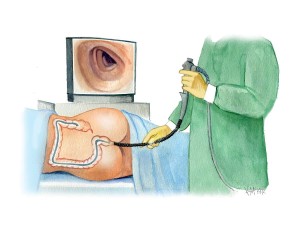
Polypectomy is a procedure in which polyps are removed from the colon, usually during a colonoscopy (figure 1). Up to 90% of polyps can be safely and completely removed by colonoscopy.
How are polyps removed?
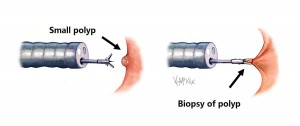
For small polyps less than 5mm in size polypectomy is performed at the time of colonoscopy using biopsy forceps and electrocautery (figure 2).
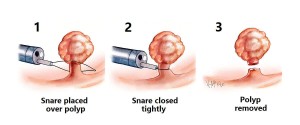
However, for larger polyps, polypectomy is performed using a wire snare and electrocautery (figure 3). You are asleep at the time so feel nothing.
Endoscopic Mucosal Resection (EMR)
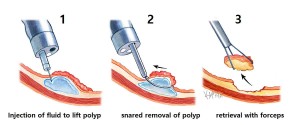
Very large polyps may require removal by Endoscopic Mucosal Resection (EMR) technique, where the polyp is first injected with a fluid to lift a flap polyp up, allowing it to be more easily and safely removed using a snare. (figure 4)
What happens after the polyp is removed?
All polyp tissue is sent to a pathologist who looks at it under the microscopy to see the type of polyp (e.g. adenomatous, inflammatory, hyperplastic or hamartomatous), and to see if there is any cancer within the polyp or suspicious features that lead to it becoming a cancer. If it is an adenomatous polyp, you will require ongoing surveillance colonoscopies in the future. If cancer is found within the polyp, your colorectal surgeon will discuss with you the surgical management.